Capital Gains Tax in Spain: The Purchase Receipts That Cut It
Spanish homes now change hands after 18 years on average, and when yours does, the tax office will want proof of what you spent on day one. Here's which purchase costs and improvements reduce your capital gains tax, what evidence still holds up two decades later, and how to build the file the week you buy.
David C. · · 11 min
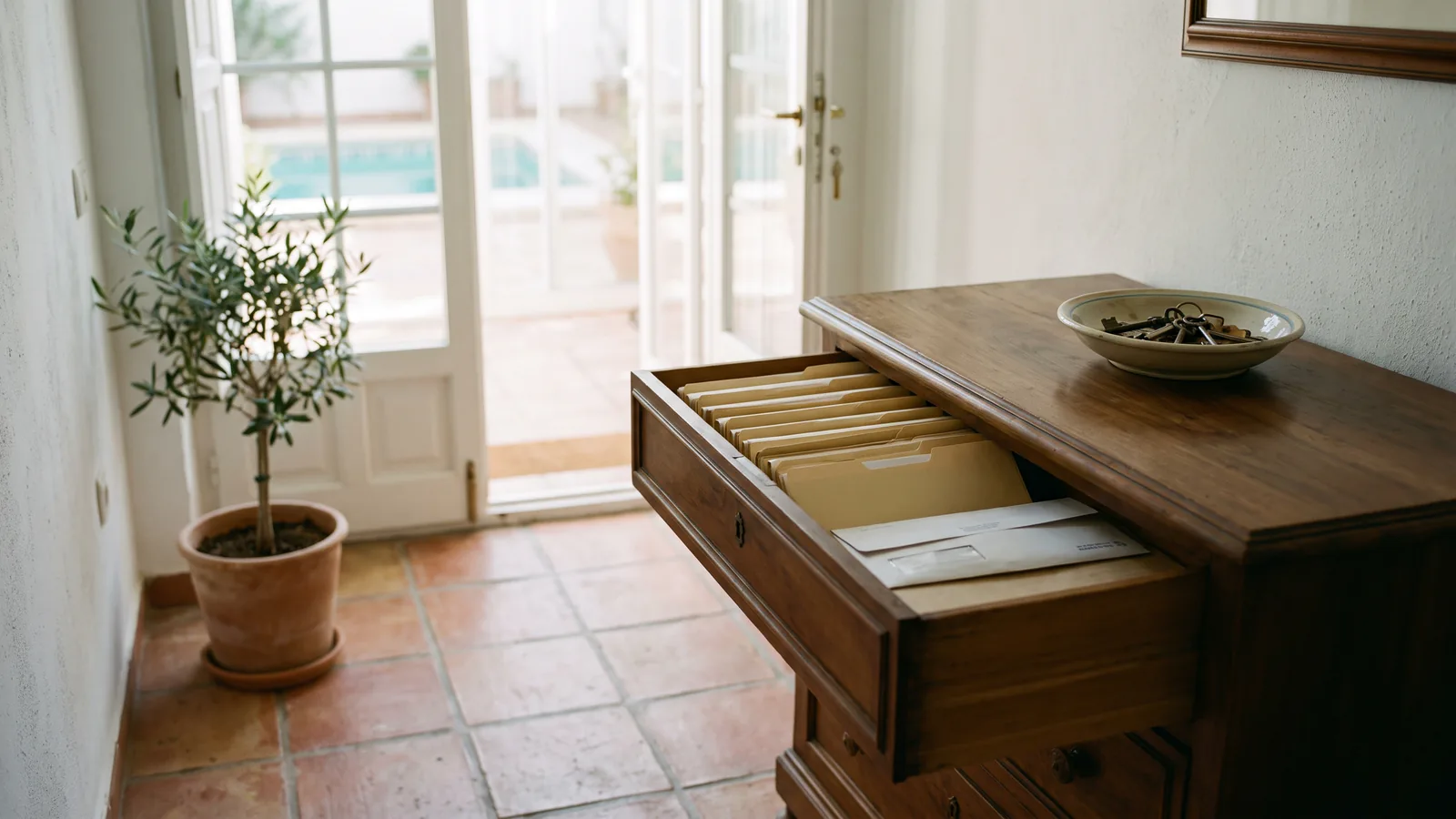
Capital gains tax in Spain is charged on the gain, not the sale price, and the gain is measured from an acquisition value that adds your purchase taxes, notary, Land Registry, gestoría and adviser fees, plus every documented improvement, to the price in the deed (Ley 35/2006, art. 35). Non-residents pay a flat 19% on that gain and residents pay between 19% and 30%. The catch is that the burden of proof sits with you, and most owners sell nearly two decades after the receipts were issued.
The short version:
- Your acquisition value is the price plus the transfer tax (ITP, or IVA and AJD on a new build), notary, registry, gestoría and adviser fees you paid, plus the cost of improvements made while you owned it.
- Repairs and upkeep don't count. Work that adds space, raises habitability or extends the building's life does, and the invoice has to show which one it was.
- Spain removed inflation indexing on property gains from 1 January 2015, so documented costs are now the main lever you have on the size of the taxable gain.
- On a €250,000 purchase sold for €400,000, a complete file is worth roughly €7,700 to €9,300 of tax in the worked example below.
- The evidence that holds up is an invoice in your name for the property plus proof of a traceable payment. Start the file the week you buy, not the month you sell.
Why the receipts matter more than you think
Spanish homeowners keep their homes far longer than they did. The Colegio de Registradores' 2025 yearbook puts the average holding period of homes sold in 2025 at 18.1 years, a record high and up from 7.3 years in 2009. Nearly two thirds of the homes sold that year (65.95%) had been owned for more than ten.
That gap is the whole problem. The notary invoice, the gestoría bill and the transfer to the builder who enclosed your terrace were filed somewhere in the year you bought. Eighteen years later, two moves and a dead email account stand between you and that folder.
Inflation used to cushion the loss. Until the end of 2014, the acquisition value of a property was uplifted by official coeficientes de actualización before the gain was calculated. Ley 26/2014 deleted that rule from 1 January 2015. Today the gain is purely nominal: what you sold for, minus what you can prove you paid.
The paperwork from your purchase isn't finished with once you get the keys. Some of it could still be saving you money years later when you sell.
What can I deduct from capital gains tax when selling property in Spain?
You can add the purchase price, the transfer taxes and the notary, registry, gestoría and adviser fees you paid when buying, plus the cost of improvements, to your acquisition value. From the sale price you can subtract the selling costs you paid, such as the agent's commission and the plusvalía municipal.
The formula is article 35 of the IRPF law, and non-residents use it too, through article 24 of the non-resident tax law. The Agencia Tributaria's own page for non-resident sellers spells it out: the real price, plus improvements, plus "gastos (comisiones, Fedatario público, Registro, etc.) y tributos inherentes a la adquisición". The tax authority's binding rulings name the purchase-side items directly. Consulta V1393-26 (June 2026) lists notary, registry, gestoría, ITP and AJD or IVA, valuation, and the buyer's agency commission, "siempre y cuando hayan sido satisfechos por el adquirente".
| Cost | Counts? | Evidence to keep | If you lose it |
|---|---|---|---|
| Price paid | Yes | Purchase deed (escritura) | Notary can issue a copy |
| ITP, or IVA + AJD | Yes | Tax form (modelo 600) + payment receipt | Regional tax office holds it |
| Notary and Land Registry fees | Yes | Their invoices + bank transfer | Ask the office; may not survive 18 years |
| Gestoría, lawyer or adviser | Yes, if paid by you | Invoice naming the purchase + transfer | Often gone with the firm |
| Buyer's agent commission | Yes, if paid by you | Invoice + transfer | Often gone |
| Improvements during ownership | Yes | Itemised invoice with the property address + transfer | Usually unrecoverable |
| Mortgage interest | No | n/a | n/a |
| Repairs, painting, maintenance | No | n/a | n/a |
Note the last column. The deed and the transfer tax sit in official records, so you can usually rebuild them. The fees and, above all, the improvement invoices exist only in yours.
Costs tied to the mortgage rather than the purchase are the grey zone. Interest is excluded by law, and the binding rulings don't clearly cover the notary and registry costs of the mortgage deed itself, so keep those too and let your adviser decide.
Improvement or repair? The line that decides most claims
Work counts as an improvement when it increases the home's capacity or habitability or extends its useful life. Work that only keeps it in its current state is repair and conservation, and it doesn't count. That is the test in Consulta V1677-26, which names painting, rendering, fixing installations and replacing existing elements (heating, a lift, a security door) as repairs.
In practice, enclosing a terrace as living space, adding a pool or building an extension sits comfortably on the improvement side. Repainting before you sell does not. A large kitchen or bathroom refit is where disputes start, and the invoice wording does most of the arguing. A line reading "obras varias, 18.000 €" proves almost nothing; an itemised invoice describing what was built, with the property's address on it, proves a great deal.
Can I deduct furniture?
No. Furniture and appliances aren't part of the property, so they don't add to its acquisition value even when they're sold with it. Track them separately, because that money is no tax argument later.
Remembering you spent it is not the same as proving it
Spanish tax law puts the burden squarely on the taxpayer. Article 105.1 of the Ley General Tributaria says whoever claims a right "deberá probar los hechos constitutivos del mismo", and article 106.4 makes the invoice the priority proof for any expense. V1677-26 adds that the nature, reality, date and amount of works are facts you can prove by any lawful means. A recollection is not one of them.
The paper trail that survives an inspection has two halves:
- The invoice. Issued to you, with the supplier's tax ID, a dated description of the work and the property's address.
- The payment. A bank transfer or card payment that matches the invoice.
Mark Stücklin gave the same advice on Spanish Property Insight's forum: original invoices that describe the work and identify the property, with the caveat that tax offices don't all read them alike. A stronger file leaves less room for that variation.
What if I paid the builder in cash?
Then you have a weaker claim and possibly an illegal payment. Article 7 of Ley 7/2012 bans cash payments of €1,000 or more whenever one party acts as a business or professional, which covers almost every builder and installer (the ceiling is €10,000 for non-resident individuals). A "price without IVA" offer for cash leaves you with no invoice to claim and no transfer to back it up.
How long should you keep the records?
At least until four years after you file the tax return for the sale. That's because the tax authority's right to review a return lapses after four years (LGT art. 66), and article 70.3 keeps the duty to justify old figures alive for as long as the year they affect can still be reviewed. For an 18-year holding period, a 2026 invoice may need to survive into the late 2040s.
Is there still an inflation adjustment on Spanish capital gains?
No. The coeficientes de actualización that uplifted the purchase price of property for inflation were abolished from 1 January 2015, for residents and non-residents alike. The gain is now the nominal difference between the transfer value and the acquisition value, so every documented euro of cost reduces it one for one.
The rate that then applies depends on residence. Non-residents pay a flat 19% under article 25 of the non-resident tax law. Residents pay the savings scale in force since 2025: 19% on the first €6,000, 21% to €50,000, 23% to €200,000, 27% to €300,000 and 30% above that.
A worked example: what a lost folder costs
Take a resale townhouse in Andalucía (7% ITP) bought for €250,000 and sold for €400,000. During ownership the owners built a pool and enclosed the terrace. The selling costs, a 3% plus IVA agency commission and a plusvalía municipal assumed at €2,000, are recent, so both scenarios keep them. The only difference is whether the purchase-era file survived.
| Complete file | Deed and ITP only | |
|---|---|---|
| Purchase price | €250,000 | €250,000 |
| ITP at 7% | €17,500 | €17,500 |
| Notary, registry, gestoría | €1,550 | not provable |
| Lawyer (1% + IVA) | €3,025 | not provable |
| Pool and terrace enclosure | €36,000 | not provable |
| Acquisition value | €308,075 | €267,500 |
| Sale price less selling costs | €383,480 | €383,480 |
| Taxable gain | €75,405 | €115,980 |
| Tax as a non-resident (19%) | €14,327 | €22,036 |
| Tax as a resident (savings scale) | €16,223 | €25,555 |
Losing the folder costs a non-resident €7,709 and a resident €9,332. The resident figure assumes no other savings income that year. The notary, registry and gestoría figures come from the same estimates as our Spain buying-costs calculator, and every input is illustrative, so your own numbers will differ.
For a non-resident seller there's a second effect. The buyer must withhold 3% of the price, €12,000 here, and pay it to the tax office on modelo 211, as covered in our guide to whether you need a lawyer to buy in Spain. You then file modelo 210 to settle the real tax. With the full file, the bill is €2,327 above the amount withheld; without it, you owe €10,036 more.
Plusvalía municipal: where the deed matters and the receipts don't
The municipal tax on the increase in land value (IIVTNU) is paid by the seller. Since the 2021 reform you can show there was no gain or ask to be taxed on the real one, and that comparison uses the values in the deeds. Article 104.5 of the local finance law says expressly that costs and taxes are not added for that test.
So for the plusvalía, the deed price is the document that matters. For the main capital gains calculation, the plusvalía you pay becomes a selling cost that reduces your gain. Keep that receipt too, because it is a deduction on the sale side.
How owners who get this right keep the file
Owners who sell without a scramble treat the purchase as the first entry in the property's financial history, not a finished transaction. The week they complete, they collect the deed copy, the modelo 600 and its payment receipt, and the notary, registry, gestoría and lawyer invoices, each matched to the bank transfer that paid it. When an improvement happens, the invoice goes in on the day it's paid, with a note on what was added. Repairs go in a separate line, so nobody has to sort them out from memory later.
That habit starts at the same moment you're tracking what buying actually costs, and the two belong in one place. A renovation that runs over budget is also the one whose invoices you'll most need eighteen years on. CasaTab was built for exactly this job: every purchase cost logged by category, the invoice and payment proof attached to each one, standalone documents such as the deed kept alongside, and a household that can share access. Start your property's file in CasaTab on the day you buy, and the numbers will be ready the day you sell.
Keep the file even if you expect to pay nothing. Residents over 65 selling their main home are exempt, as are owners who reinvest the proceeds in a new main home within two years (LIRPF arts. 33.4 and 38), a relief EU and EEA residents can also claim on a former Spanish main home. Plans change in eighteen years. And if you're tax-resident elsewhere, your home country may tax the same gain: France does and credits the Spanish tax under its treaty with Spain, while Germany generally taxes it only on a sale within ten years of buying (§ 23 EStG). Same file, two tax returns.
From the record to the sale
Keeping a proper record of what you paid and invested in the property will make life easier when the time comes to sell. But selling well involves much more than calculating the tax bill. The Spanish Property Insight guide to selling property in Spain explains how to plan, structure and manage the whole sales process, from preparing the property and deciding how to market it through to negotiating and completing the sale.